
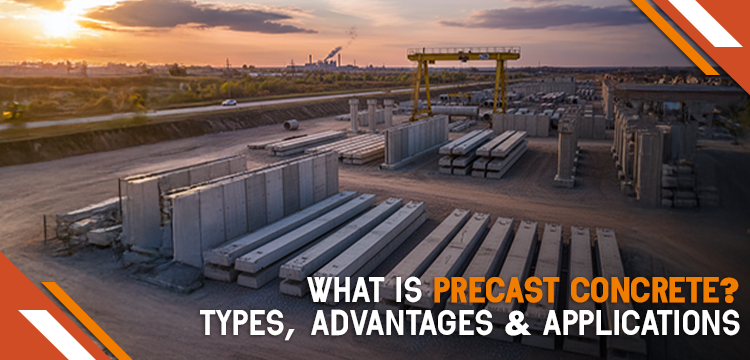
What is Precast Concrete? Types, Advantages & Applications
Table of Contents:
Precast concrete has revolutionized the construction industry by offering a faster, more efficient, and cost-effective alternative to traditional on-site casting methods. Whether you’re building residential complexes, commercial structures, or infrastructure projects, precast concrete solutions provide superior quality and reliability.
What is Precast Concrete?
Precast concrete refers to structural elements that are manufactured in a controlled factory environment and then transported to the construction site for assembly. Unlike conventional concrete that is poured and cured on-site, precast concrete is cast in molds at specialized manufacturing facilities where conditions can be precisely controlled. This method ensures consistent quality, better durability, and superior finishes that meet stringent building standards.
Types of Precast Concrete
- Precast Concrete Beams and Columns are fundamental structural elements used in building frameworks. These components provide excellent load-bearing capacity and are essential for constructing multi-story buildings efficiently.
- Precast Concrete Slabs serve as floor and roof elements in residential and commercial projects. They offer superior flatness and uniformity compared to site-cast alternatives, resulting in better aesthetics and functionality.
- Precast Concrete Walls and panels are used for external facades, partition walls, and building enclosures. They provide excellent thermal and acoustic insulation properties while reducing construction time significantly.
- Precast Concrete Pipes are widely used in utility infrastructure, including water supply systems, sewage lines, and drainage applications. Their durability ensures long service life with minimal maintenance.
- Precast Concrete Blocks and Pavers are popular for masonry work, pavements, and decorative applications. They offer consistent dimensions and superior strength compared to traditional concrete blocks.
Advantages of Precast Concrete
- Quality Control: Factory manufacturing ensures precise quality standards with rigorous testing and inspection at every stage of production.
- Speed of Construction: Since elements are manufactured simultaneously with site preparation, overall project timelines are significantly reduced, accelerating project completion.
- Cost Efficiency: Reduced labor requirements, minimized waste, and faster construction translate into substantial cost savings for builders and developers.
- Durability and Strength: Controlled curing conditions and high-quality materials result in stronger, more durable structures with extended lifespans.
- Environmental Benefits: Precast concrete manufacturing generates minimal waste and allows for recycling of materials, making it an eco-friendly construction option.
- Design Flexibility: Modern precast manufacturing enables various architectural finishes, colors, and textures, allowing creative design possibilities without compromising structural integrity.
- Safety Improvements: Factory-controlled production reduces on-site accidents and hazards associated with traditional concrete casting methods.
Applications of Precast Concrete
Precast concrete finds extensive applications across diverse sectors. In residential construction, it’s used for building frames, floor systems, and wall panels. Commercial projects utilize precast elements for office buildings, shopping malls, and institutional structures. Infrastructure development relies heavily on precast concrete for bridges, overpasses, tunnels, and utility systems.
The agricultural and industrial sectors use precast concrete for storage facilities, silos, and equipment foundations. Public utilities depend on precast concrete pipes for water distribution and wastewater management systems.
The Role of TMT Reinforcement in Precast Concrete
While precast concrete elements form the structural framework, they require robust reinforcement to maximize strength and durability. This is where quality TMT (Thermo-Mechanically Treated) bars play a crucial role. TMT bars provide superior ductility, tensile strength, and corrosion resistance—essential properties for reinforcing precast concrete elements, especially in challenging environmental conditions.
Shree TMT’s steel TMT bars are engineered to meet international standards, offering consistent quality and performance. When precast concrete is reinforced with premium TMT bars like those from Shree TMT, the resulting structures demonstrate enhanced load-bearing capacity, better crack resistance, and extended durability. This combination ensures that precast concrete elements maintain their structural integrity over decades.
Conclusion
Precast concrete represents a paradigm shift in modern construction methodology. Its combination of quality, speed, cost-effectiveness, and sustainability makes it the preferred choice for contemporary building projects. However, the true value of precast concrete emerges when it’s reinforced with high-quality TMT bars that provide the necessary tensile strength and flexibility.
At Shree TMT, we recognize that excellent construction outcomes depend on superior materials at every stage. Our TMT bars, manufactured from secondary steel using advanced thermo-mechanical treatment, are the ideal reinforcement choice for precast concrete manufacturing. When builders and developers choose Shree TMT bars for their precast concrete projects, they’re investing in structures built to last—combining the efficiency of precast construction with the reliability of premium steel reinforcement.


