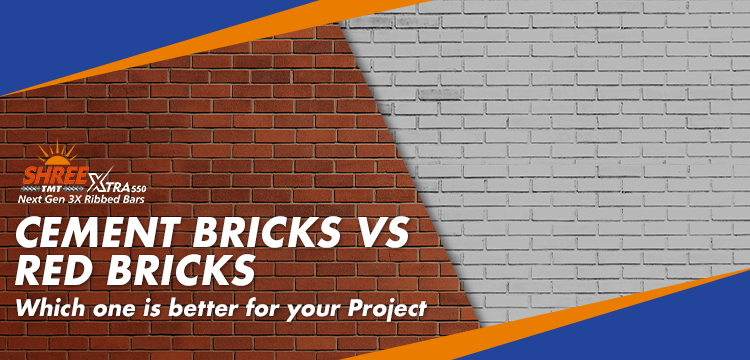
Cement Bricks vs Red Bricks: Which One is Better for Your Project?
Table of Contents:
When planning a construction project, one of the fundamental decisions you’ll make is selecting the right masonry material. While TMT steel bars form the backbone of structural reinforcement, the choice between cement bricks and red bricks significantly impacts your building’s durability, aesthetics, and overall cost. Let’s break down both options to help you make an informed decision for your next project.
Understanding Red Bricks: The Traditional Choice
Red bricks have been a cornerstone of Indian construction for centuries. Made from clay mixed with sand and fired in kilns at high temperatures, these bricks develop their characteristic reddish color and impressive durability. They’re the gold standard for load-bearing walls and have proven their longevity across countless structures.
The strength and thermal mass of red bricks make them ideal for buildings in varied climates. They provide excellent insulation, keeping interiors cool in summer and warm in winter. Their absorption capacity also promotes better adhesion with mortar, resulting in stronger masonry joints. Additionally, red bricks are widely available and relatively affordable, making them a cost-effective choice for most construction projects.
However, red bricks come with challenges. They’re labor-intensive to produce, have higher water absorption rates, and can be susceptible to efflorescence (white salt deposits) if not properly sealed. Their aesthetic appeal, while charming, may not suit modern architectural designs.
Cement Bricks: The Modern Alternative
Cement bricks, also known as concrete bricks, are manufactured using cement, sand, and aggregates under controlled conditions. This standardized production process ensures consistent quality, uniform dimensions, and superior structural properties. Unlike red bricks, cement bricks have lower water absorption and higher compressive strength, making them excellent for demanding applications.
The precision-engineered nature of cement bricks translates to faster construction timelines and reduced mortar wastage. They’re ideal for structures requiring high strength-to-weight ratios and work exceptionally well in areas prone to flooding or high moisture. Their dimensional accuracy also means cleaner, more professional finishes that require less plastering.
The downsides include higher initial costs and lesser thermal insulation compared to red bricks. They also generate more heat, which can make interiors uncomfortable in hot climates if not properly managed through architectural design.
Making the Right Choice
Your decision should be guided by several factors. For traditional construction in moderate climates with standard load requirements, red bricks remain an excellent choice. They offer proven performance, natural insulation, and aesthetic warmth that many builders and homeowners prefer.
Opt for cement bricks when constructing in flood-prone areas, for structures with high-rise requirements, or when you need superior structural precision. They’re particularly valuable in commercial projects where timeline adherence is critical and strength demands are higher.
Consider a hybrid approach: use red bricks for non-load-bearing interior walls and external aesthetics while selecting cement bricks for critical structural elements. This strategy optimizes both cost-effectiveness and performance.
The Complete Picture
Remember, whether you choose red or cement bricks, your project’s success depends on quality materials across all components. This includes partnering with reliable suppliers for other essentials like high-grade TMT steel bars. At Shree TMT, we understand that every construction decision matters—from the bricks forming your walls to the steel reinforcement ensuring structural integrity.
Take time to evaluate your project’s specific requirements, climate conditions, budget constraints, and aesthetic goals. Consult with structural engineers and experienced contractors who can provide context-specific recommendations. The “better” brick is simply the one that best serves your project’s unique needs.
Build smart. Build strong. Build to last.