Concrete 101: Everything You Need to Know Before Your Next Build
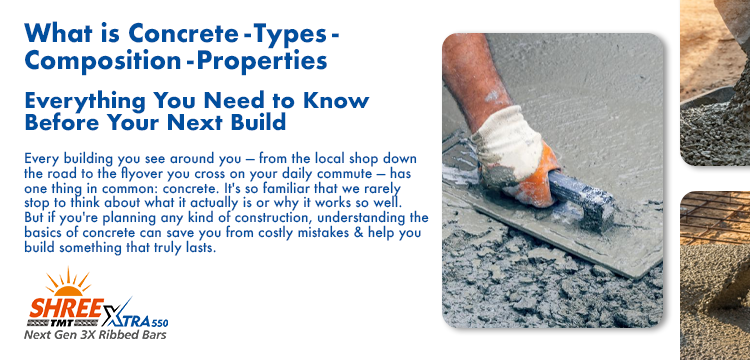
Every building you see around you — from the local shop down the road to the flyover you cross on your daily commute — has one thing in common: concrete. It’s so familiar that we rarely stop to think about what it actually is or why it works so well. But if you’re planning any kind of construction, understanding the basics of concrete can save you from costly mistakes and help you build something that truly lasts.
What is Concrete?
Concrete is a composite material formed by mixing cement, water, and aggregates such as sand, gravel, or crushed stone. When these ingredients are combined in the right proportions, a chemical reaction called hydration takes place, binding everything together into a hard, stone-like mass. The result is a material that is exceptionally strong in compression and can be moulded into virtually any shape before it sets.
Composition of Concrete
A standard concrete mix is made up of four primary components:
- Cement (10–15%) – Ordinary Portland Cement (OPC) is the most common binder. It reacts with water to form the paste that holds the mix together.
- Water (15–20%) – Water activates the cement through hydration. The water-to-cement ratio is one of the most critical factors affecting concrete strength.
- Fine Aggregate / Sand (25–30%) – Sand fills the gaps between larger particles, improving density and workability.
- Coarse Aggregate / Gravel (40–50%) – Crushed stone or gravel provides the bulk and structural strength of the mix.
Admixtures may also be added to modify setting time, enhance durability, or improve workability depending on the project requirements.
Common Types of Concrete
Plain Cement Concrete (PCC) – The simplest form, used for levelling courses and non-structural work where high tensile strength is not needed.
Reinforced Cement Concrete (RCC) – Concrete reinforced with steel bars – such as Shree TMT bars – to handle both compressive and tensile loads. RCC is the standard for columns, beams, slabs, and foundations in residential, commercial, and infrastructure projects.
Ready-Mix Concrete (RMC) – Batched at a central plant and delivered in transit mixers. RMC offers consistent quality and saves on-site labour.
Prestressed Concrete – Steel tendons are tensioned before or after casting to improve the load-bearing capacity. Widely used in bridges and large-span structures.
Lightweight Concrete – Made with lightweight aggregates like expanded clay or pumice. Ideal for reducing dead load on a structure.
Key Properties of Concrete
- Compressive Strength – Concrete’s ability to resist crushing loads. Graded as M15, M20, M25, and so on, where the number indicates strength in MPa.
- Workability – How easily the mix can be placed, compacted, and finished. Measured by the slump test.
- Durability – Resistance to weathering, chemical attack, and wear over the structure’s lifespan.
- Tensile Strength – Relatively low on its own, which is why steel reinforcement (TMT bars) is essential in structural concrete.
- Permeability – Lower permeability means better protection for the embedded steel, extending the life of an RCC structure.
Why Reinforcement Matters
At the end of the day, concrete is only as good as what goes into it — and that includes the steel that reinforces it. The right concrete mix paired with high-grade TMT bars is what separates a structure that simply stands from one that stands strong for generations. So the next time you plan a build, pay as much attention to your reinforcement as you do to your concrete grade. It’s the combination of the two that makes all the difference.
Build stronger with Shree TMT. Whether you are constructing a family home or a multi-storey commercial building, pairing the right concrete mix with Shree TMT bars ensures a structure that is safe, durable, and built to last.