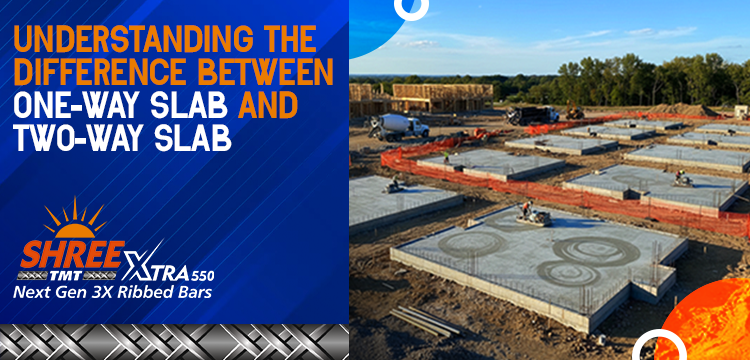
Understanding the Difference Between One-Way Slab and Two-Way Slab
With modernisation in construction, reinforced concrete slabs play a crucial role in providing structural stability and durability to floors and roofs. However, not all slabs function the same way—engineers classify them primarily into two categories:
- one-way slabs and
- two-way slabs.
Understanding the difference between the two helps architects and builders choose the right slab system for safety, cost-efficiency, and overall performance.
What Is a One-Way Slab?
A one-way slab carries loads in a single direction, usually over two opposite supports such as beams or walls. It is designed so that the main reinforcement runs in the shorter direction, which is where the slab bends and takes most of the load. For a slab to function as a one-way slab, the longer span (L) should be at least twice the shorter span (B), making the ratio L/B ≥ 2.
One-way slabs are common in structures like verandas, balconies, corridors, and smaller residential floors. Because the load transfer occurs in only one direction, they require less steel reinforcement and are generally thicker to maintain strength. This makes them a more economical choice for shorter spans up to around 3.6 meters. However, since they only bend in one direction, their deflected shape resembles a cylinder.
What Is a Two-Way Slab?
In contrast, a two-way slab carries loads in both directions, supported on all four sides by beams, columns, or walls. It bends in two perpendicular directions under loading, distributing the stresses more evenly. The two-way slab is identified when the ratio of the longer span to the shorter span is less than 2 (L/B < 2).
This type of slab is commonly used in floors of multi-story buildings, parking structures, and large halls where both the short and long spans contribute to load distribution. Two-way slabs require more reinforcement placed in both directions, making them thinner but more structurally efficient. Because they handle complex load patterns, they often have a dish-shaped deflection. Though their design and reinforcement detailing are more elaborate, this system offers greater structural integrity for larger, open areas.
Key Differences Between One-Way and Two-Way Slabs
| Feature | One-Way Slab | Two-Way Slab |
| Load Distribution | In one direction | In both directions |
| Support | Two opposite sides | All four sides |
| Reinforcement | One direction (shorter span) | Both shorter and longer spans |
| Deflection Shape | Cylindrical | Dish-shaped |
| Cost | More economical | More expensive |
| Suitable Span | Up to 3.6 m | Up to 6 m |
| Steel Requirement | Less | More |
| Common Use | Residential balconies, passages | Office floors, large halls |
Choosing the Right Slab
The choice between a one-way and a two-way slab depends on several practical factors, such as span length, structural design, budget, and architectural requirements. For smaller spans and simpler layouts, a one-way slab offers a cost-effective solution. However, when dealing with wide floor spaces needing minimal support columns, the two-way slab becomes the better structural choice due to its ability to spread loads evenly in two directions.
Understanding these fundamental differences and pairing them with premium quality reinforcement steel from Shree TMT helps in making informed decisions that balance structural integrity with cost-effectiveness, ultimately leading to safer, stronger, and more durable construction projects. Shree TMT bars are engineered to provide superior tensile strength, excellent bendability, and enhanced corrosion resistance—qualities essential for both one-way and two-way slab construction. With consistent quality and adherence to IS standards, Shree TMT bars ensure that your slabs can withstand the test of time, whether they’re distributing loads in one direction or both.